So I still haven't received my first message from the Economist that I signed up for last week, so I guess I'm still resorting to writing about my life. Lately I've been getting more interested in setting up an LTSP server running edubuntu (a version of Linux designed expressly for K-12 use) and using thin clients in classrooms. Seeing as how my school has a plethora of lousy computers, this setup seems like the best solution to our technology needs. I was disappointed to read this afternoon that we'll likely need some more RAM to power the servers themselves, but we are slated to receive 80 new P3 computers next month, so maybe enough of them will come with 256 MB of memory to piece together a few good terminal servers for my edubuntu project. If not I guess we'll just be running some slow setups.
In other news, I'm hoping to start a blog on my own experiences in the lab trying to come up with creative things for the kids to do, but I think a whole website might be more appropriate. Maybe that's what hartmanbot will have to eventually become. It seems like a worthy cause, which probably means someone is already doing it. I haven't really investigated that much.
Finally, Benita and I booked tickets to Costa Rica for this summer and we're both pretty excited about the trip. We take off at 2am on June 30th and have an 8 hour layover in Panama City before heading on to San Jose. We're going with a few other people, so it should be a really fun trip. I'll be sure to blog about it a bit when the date arrives. Cheers -joe
Wednesday, February 28, 2007


Thursday, February 22, 2007
Hartmanbot.com
So I finally registered a site and started putting stuff up on it. Check it out if you have some time to kill: hartmanbot.com
Hartmanbot was the name of my botball robot last year. I used to challenge the teams of students in my elective class to sumo matches against Hartmanbot and I think he only lost one time, maybe twice. In any case, pretty much all the other names I would choose were already taken. I guess Hartman is a more popular name than I realized.
So the best part of getting a site is that I have been learning a lot of new CSS programming stuff. I actually rebuilt the entire site from an existing template, but the new one is all in CSS, which I'm really enjoying experimenting with. Oh, and I've also started a site for the Geosense tournament I'm planning on holding later this year at Albert Einstien. You can check it out here, it's also all in CSS.
Finally, I've been trying to think of some way to be more consistent with my posts, and I decided that I needed some sort of catalyst for writing. Since I pretty much only get any informational knowledge from The Economist, I immediately thought of some way to incorporate that into my blog. So I think what I'll do is comment each week on one of the articles that The Economist features in one of its free weekly emails. There are three that I signed up for: business this week, politics this week, and from the editors desk (or something like that). I'm leaning towards the editor's desk right now, but we'll just have to see what I think of them. Hopefully with a little more regular posting I can get some other people's opinions on some topics and I can stop just being an Economist mouthpiece repeating back everything I read within their pages. Cheers -joe
Hartmanbot was the name of my botball robot last year. I used to challenge the teams of students in my elective class to sumo matches against Hartmanbot and I think he only lost one time, maybe twice. In any case, pretty much all the other names I would choose were already taken. I guess Hartman is a more popular name than I realized.
So the best part of getting a site is that I have been learning a lot of new CSS programming stuff. I actually rebuilt the entire site from an existing template, but the new one is all in CSS, which I'm really enjoying experimenting with. Oh, and I've also started a site for the Geosense tournament I'm planning on holding later this year at Albert Einstien. You can check it out here, it's also all in CSS.
Finally, I've been trying to think of some way to be more consistent with my posts, and I decided that I needed some sort of catalyst for writing. Since I pretty much only get any informational knowledge from The Economist, I immediately thought of some way to incorporate that into my blog. So I think what I'll do is comment each week on one of the articles that The Economist features in one of its free weekly emails. There are three that I signed up for: business this week, politics this week, and from the editors desk (or something like that). I'm leaning towards the editor's desk right now, but we'll just have to see what I think of them. Hopefully with a little more regular posting I can get some other people's opinions on some topics and I can stop just being an Economist mouthpiece repeating back everything I read within their pages. Cheers -joe
Tuesday, February 13, 2007
The ROOTS!


So I finally got to see the Roots last night. Great show at the House of Blues in San Diego. They had a four piece guest horns section that was incredible, and of course the regular members were great as well. There were three definite highlights for myself, the first being that it was the bass player's birthday last night so at one point the whole band stopped the show and we all sang Happy Birthday to him. The second was the very end of the show, when Black Thought did his best James Brown impression and the horns section really got going, it was like a soul concert, and I can't say how privileged I felt to witness it. There just aren't that many bands out there doing music like that anymore, just great. My favorite part though was the first song the band did for their encore. They all came back out to applause and started in with the guitar tune of "Roxanne" which the newly reunited Police just performed at the Grammy's the night before. Then Questlove himself did his best Sting impression and the place just exploded. I can't believe the crowd had that much energy that far into the show, but it was just infectious and everybody started yelling and jumping around. Good times all around.
Thursday, September 21, 2006
Back to School Night
Here I am, wondering if anyone is going to come up to see my amazing computer lab here at Einstein. I figured since it looks like such an occurrance is unlikely, I'd at least try to get something of some value done. But then I just decided to update my blog.
So I started taking students in the lab this week, and for the most part it's been pretty good. I'm still getting adjusted to the little ones (K - 2) but I think I'm doing okay. At the staff retreat a few weeks ago some of the 1st grade teachers were emphasizing to me how specific I'd need to be with the students. "You've got to tell them EVERYTHING," they'd tell me, eyes widening with each syllable. "How to walk, how to talk, where the bathrooms are...." "Oh, YES! The BATHROOMS, make sure you tell them where the BATHROOMS are," they'd say, lighting into stories of students past who were unable to control their bladder, bowels or both at some point of the school day.
These nightmares got me thinking though. How could I teach the students how to walk? Don't they already know how to walk? Eventually I got the idea to have the students walk "like robots" on the way to and from the lab. They would have to walk with stiff arms and legs and look straight ahead. Of course, the first images that popped into my head when I thought of this were the lines of militant North Korean soldiers high-stepping past Kim Jong Il. That would never do. "Besides," I thought, "what kind of school would this look like to some random bystander who just happened to witness me marching little six year olds through the halls?" I'm sure it isn't the kind of impression that the school is interested in projecting in any case.
Of course, all of this doubting was out the window with my first class of the week. A first grade troop of students quickly taught me exactly how crazy it can get on a simple walk back to the classroom. Not to mislead you, nothing extraordinary happened at all, it was just six year olds being six year olds. Walking without paying attention to where they were going, talking to their friends next to them, chasing after a bug or two enroute....
So with the next class I tried the "robot walk" bit. "There are three things you need to know about robots," I began. "The first is that robots don't talk. 'But Mr. Hartman, Mr. Hartman' you'll say. 'I saw a movie with robots in it and they talked!'" I whined using my best five year old voice. "Those aren't robots, those are CYBORGS! Robots don't talk."
"The second thing you need to know about robots is that they always walk in a straight line. Humans? Humans walk all over the place. They walk left, they walk right, they might even walk in a circle. But robots always walk in a straight line."
"The last thing you need to know about robots is... they have NO elbows! If a robot wants to scratch his head, he has to use his shoulder," I said, my ear rubbing against the sleeve of my shirt.
The kids ate it up, and I had no problems for the rest of the week making all of the students walk like robots to and from the lab. Now, I still kind of worry what it might look like to a random bystander, but I decided that most people, for better or worse, have simply forgotten what it is like to not only have a six year old child around, but to be a six year old child. They simply have the attention span of a gnat, and it is quickly the most infuriating thing in your life to try and get 20 of them to walk in a somewhat organized and timely fashion anywhere without screaming like banshees. I don't think there's a mother in the world that would convict me, but part of me still misses the simplicity of simply asking my 6th graders to just go somewhere and having them do it. -joe
So I started taking students in the lab this week, and for the most part it's been pretty good. I'm still getting adjusted to the little ones (K - 2) but I think I'm doing okay. At the staff retreat a few weeks ago some of the 1st grade teachers were emphasizing to me how specific I'd need to be with the students. "You've got to tell them EVERYTHING," they'd tell me, eyes widening with each syllable. "How to walk, how to talk, where the bathrooms are...." "Oh, YES! The BATHROOMS, make sure you tell them where the BATHROOMS are," they'd say, lighting into stories of students past who were unable to control their bladder, bowels or both at some point of the school day.
These nightmares got me thinking though. How could I teach the students how to walk? Don't they already know how to walk? Eventually I got the idea to have the students walk "like robots" on the way to and from the lab. They would have to walk with stiff arms and legs and look straight ahead. Of course, the first images that popped into my head when I thought of this were the lines of militant North Korean soldiers high-stepping past Kim Jong Il. That would never do. "Besides," I thought, "what kind of school would this look like to some random bystander who just happened to witness me marching little six year olds through the halls?" I'm sure it isn't the kind of impression that the school is interested in projecting in any case.
Of course, all of this doubting was out the window with my first class of the week. A first grade troop of students quickly taught me exactly how crazy it can get on a simple walk back to the classroom. Not to mislead you, nothing extraordinary happened at all, it was just six year olds being six year olds. Walking without paying attention to where they were going, talking to their friends next to them, chasing after a bug or two enroute....
So with the next class I tried the "robot walk" bit. "There are three things you need to know about robots," I began. "The first is that robots don't talk. 'But Mr. Hartman, Mr. Hartman' you'll say. 'I saw a movie with robots in it and they talked!'" I whined using my best five year old voice. "Those aren't robots, those are CYBORGS! Robots don't talk."
"The second thing you need to know about robots is that they always walk in a straight line. Humans? Humans walk all over the place. They walk left, they walk right, they might even walk in a circle. But robots always walk in a straight line."
"The last thing you need to know about robots is... they have NO elbows! If a robot wants to scratch his head, he has to use his shoulder," I said, my ear rubbing against the sleeve of my shirt.
The kids ate it up, and I had no problems for the rest of the week making all of the students walk like robots to and from the lab. Now, I still kind of worry what it might look like to a random bystander, but I decided that most people, for better or worse, have simply forgotten what it is like to not only have a six year old child around, but to be a six year old child. They simply have the attention span of a gnat, and it is quickly the most infuriating thing in your life to try and get 20 of them to walk in a somewhat organized and timely fashion anywhere without screaming like banshees. I don't think there's a mother in the world that would convict me, but part of me still misses the simplicity of simply asking my 6th graders to just go somewhere and having them do it. -joe
Tuesday, September 05, 2006
Okay, so I know it's been a while since I posted, but now that I'm trying to keep a running blog for my new job as the technology guy at Albert Einstein Academy, I thought it wouldn't take much for me to blog some on my own neglected site. I guess this new job is the biggest thing I've got going right now. It seems like it's going to be pretty cool. A new middle school is starting up here this year, so that's always an interesting development to undertake. Thankfully I'm only working with the established elementary staff and students (this year). We'll have to see. I think it is all really interesting to witness (by all, I mean the chaos confusion and utter disorganization that accompanies trying to open a new school). Hopefully if I ever end up starting a school in Africa, I'll be able to dodge some of the more devastating bullets by remembering what I've seen both here and at High Tech. Well, I'd better get started on my other blog for now. Hopefully someone around here will find it useful in some way. Cheers -joe
Monday, March 06, 2006
First day as a noobie
I decided to sign up for a MapleStory account several weeks ago and mentioned the idea to my students, becoming instantly inundated with advice and ideas about what world to play in and what job to take (magician, warrior, thief, or bowman). I even took the time to call my cousin and ask for his advice. It wasn't until nine days ago that I actually signed up for the account though, using a couple of e-mail messages my cousin had written me to guide my decisions. I even gave him a call as I got my username and password, just to make sure I was doing everything ok.
My cousin had mentioned that he could "train" me in the game, but as I began playing I realized that I was stuck on a training level, apart from the main game where he was playing and thus, unable to be "trained" by him. The idea of "training" levels in games is relatively new, a product of the digital native generation. As I child I used to pore over manuals to video games I had just bought in attempts to understand exactly how the game worked and how it was played. Such a resource is rarely necessary in modern video games though, as the manual to play is frequently built into the game's first levels and players are either forced or encouraged to go through some sort of initiation stage to learn the basics of game control and operation.
Believing the training ground to be the only barrier between myself and my "training" at the hands of my cousin, I was overly anxious to leave the training ground and join the main island of players. Had I joined the game without prior knowledge and advice from my students and cousin though, I'm sure I would have been more receptive to the lessons being taught on the training island of MapleStory.
I did learn more about the basic operations of the game in the training ground though, mainly how to complete a quest for a non-player character (NPC) and how the map function operates in the game. I also learned how to use the chat feature of the game as my cousin answered various questions I had about the training island and how to advance to the main island in the game.
When I finally did make it to the main island, I immediately contacted my cousin about training me. He informed that there was a good area to train near Hensys, a town I located on the map and headed towards. On my way to Hensys I passed by several NPCs and talked with them, accepting more quests and learning about which animals I could defeat easily and which were too difficult for me to kill. Playing for only a couple of hours, I quickly learned the controls of the game, strategies for moving within the world, and how to communicate with another player with the game's chat program. The second day I would learn more about the most important aspect of the game: levelling.
My cousin had mentioned that he could "train" me in the game, but as I began playing I realized that I was stuck on a training level, apart from the main game where he was playing and thus, unable to be "trained" by him. The idea of "training" levels in games is relatively new, a product of the digital native generation. As I child I used to pore over manuals to video games I had just bought in attempts to understand exactly how the game worked and how it was played. Such a resource is rarely necessary in modern video games though, as the manual to play is frequently built into the game's first levels and players are either forced or encouraged to go through some sort of initiation stage to learn the basics of game control and operation.
Believing the training ground to be the only barrier between myself and my "training" at the hands of my cousin, I was overly anxious to leave the training ground and join the main island of players. Had I joined the game without prior knowledge and advice from my students and cousin though, I'm sure I would have been more receptive to the lessons being taught on the training island of MapleStory.
I did learn more about the basic operations of the game in the training ground though, mainly how to complete a quest for a non-player character (NPC) and how the map function operates in the game. I also learned how to use the chat feature of the game as my cousin answered various questions I had about the training island and how to advance to the main island in the game.
When I finally did make it to the main island, I immediately contacted my cousin about training me. He informed that there was a good area to train near Hensys, a town I located on the map and headed towards. On my way to Hensys I passed by several NPCs and talked with them, accepting more quests and learning about which animals I could defeat easily and which were too difficult for me to kill. Playing for only a couple of hours, I quickly learned the controls of the game, strategies for moving within the world, and how to communicate with another player with the game's chat program. The second day I would learn more about the most important aspect of the game: levelling.
Saturday, March 04, 2006
Maple Story Week 1
Well, I've just got the green light from my professor to use this blog as data (how often do you get to make up your own data to use in a study?) so I guess I better get to work before I forget too much. I won't waste your time by telling you about the game itself, if you're curious you can read all about it on wikipedia here. The first time I heard about the game was from my aunt, who was appalled by two things about it: one that her two sons (ages 7 and 12) were both so engrossed by it, and two that it was free for them to play. I was familiar with MMORPG's, specifically EverQuest, the attributes of which had been explained to me in minutae by a former co-worker at The Olive Garden several years ago during my table waiting days. When I was a young lad though, one of the main draws for new video games was improved (more realistic) graphics. The fact that EverQuest had an immersible, three dimensional, and fully interactive world with which to engage enabled me to at least somewhat understand the appeal. You can imagine my surprise then, to see MapleStory for the first time as a side scrolling two-dimensional game much closer in visual resemblance to Super Mario Bros. then EverQuest.
"What is the point?" I asked my cousin (age 12)
"There is no point," he explained. "It's for little kids, but it's really addictive."
I lost interest pretty quickly at that point, but each week when I returned for dinner with my family, I noted the absurd amount of time my cousins spent in the game. I may have even asked a few more detailed questions of my cousin in attempts to better understand the game, but the truth is that the idea of interacting with dozens ( much less hundreds or thousands) of people at the same time was intimidating to me.
"What will they think of me? Will I be a joke? Will I be ridiculed?" were all thoughts that passed through my head while merely thinking about playing the game. I should explain that I'm not a very competitive person by nature, but I don't like losing either, and the idea of a game where there aren't any losers was still difficult for me to grasp. I suppose the reason I was hesitant to join the game earlier (aside from being very busy) is similar to the reason I don't start surfing: I don't want to go through the "newbie" period that all beginners must suffer through.
What finally grabbed my attention with MapleStory though was when I noticed how many of my 6th grade students were involved in the game. At that point I started asking my cousins more about the game and when the opportunity came up to do a case study for my Ed 690 class, I immediately thought of MMORPG's and MapleStory. I'll post more tomorrow about my first day as a Mapler. -joe
"What is the point?" I asked my cousin (age 12)
"There is no point," he explained. "It's for little kids, but it's really addictive."
I lost interest pretty quickly at that point, but each week when I returned for dinner with my family, I noted the absurd amount of time my cousins spent in the game. I may have even asked a few more detailed questions of my cousin in attempts to better understand the game, but the truth is that the idea of interacting with dozens ( much less hundreds or thousands) of people at the same time was intimidating to me.
"What will they think of me? Will I be a joke? Will I be ridiculed?" were all thoughts that passed through my head while merely thinking about playing the game. I should explain that I'm not a very competitive person by nature, but I don't like losing either, and the idea of a game where there aren't any losers was still difficult for me to grasp. I suppose the reason I was hesitant to join the game earlier (aside from being very busy) is similar to the reason I don't start surfing: I don't want to go through the "newbie" period that all beginners must suffer through.
What finally grabbed my attention with MapleStory though was when I noticed how many of my 6th grade students were involved in the game. At that point I started asking my cousins more about the game and when the opportunity came up to do a case study for my Ed 690 class, I immediately thought of MMORPG's and MapleStory. I'll post more tomorrow about my first day as a Mapler. -joe
Wednesday, March 01, 2006
Maple Story
Well, it seems as though another project for me to blog about has entered my life. This time the culprit is the popular MMORPG (massive multiplayer online role playing game) Maple Story. A couple of days ago I joined the game as part of a Case Study I'll be producing for my Introduction to Evaluative Research class. I meant to start blogging my experiences as soon as I signed up, and now that I think about it I probably should have started blogging about it all as soon as I thought of the idea. Now I've already reached Level 7 and I still haven't said a thing. I'll do my best to remedy that situation as soon as possible. -joe
Monday, August 01, 2005
The Forbidden City and The Great Wall
Last Saturday I caught a bus and took it a few stops south to go see The Forbidden City and Tienamen Square and everything else tourists go to Beijing to see. I got off the bus a little early having seen a McDonalds and not eaten yet, and afterwards just wandered along the road I knew led to Tienamen Square. Just ambling along, I noticed a fair sized gathering of people taking photographs of a large Chinese gate with some guards nearby. The gate looked pretty nice, pretty big too, but I honestly didn't know why people were photographing it. Nice, big gates abound in China, security guards too, so I couldn't figure out what was so special about this particular gate that had compelled so many people to capture it on film. I momentarily considered just walking on by the crowd, but then thought better and stopped to watch everyone. Just past the gate and between two guards was a large red wall, not unlike the one that runs along the entire road. This wall made it impossible to see what was beyond the gate and, while it seemed to be acceptable to venture inside, I noticed that nobody did. I decided to pull out my tourist map and figure out exactly what the underwhelming thing I was looking at really was. To my surprise, my map seemed to suggest that this gate was the entrance to Tienamen Square. As I looked very carefully again at my map, a young Taiwanese man approached me and asked if he could look over my shoulder. He was looking for somewhere to get lunch.
"This is Tienamen Square?"
"Yes, Tienamen Square."
"Can you go in there?" I asked, motioning through the gate. The young man laughed.
"No."
Apparently Tienamen Square is the Chinese equivalent of the White House, except under far greater cover. I still found it such an uneventful site, I didn't even bother to take a digital photograph of it. What I did do was begin to wonder exactly what it was I had seen so many years ago on television during the famous student protests. If it wasn't here at Tienamen Square, it must have been nearby. I crossed under the boulevard to the other side of the street, pulled out my map again, and then decided to cross back. I walked further down the street, looking for a way into what my map showed as The Palace Museum, which appeared to be just over the wall broken by the gate at Tienamen Square. I came across a small side street and walked a ways down it, hoping to find a side way into the Palace Museum.
"Shouldn't there be throngs of tourists around here?" I thought to myself and, noting the lack of any, turned around again to continue along my original course. I was getting quite frustrated at the sight of the continuous red wall that ran alongside me without every allowing access to that which it protected (not to mention the lack of public toilets), when I suddenly came to a corner of the wall that opened up into a vast expanse with an absolute throng of tourists. A prominent 20 foot tall painting of Chairman Mao above an arch in the wall signalled that I had at last found what I was looking for. The walls of The Forbidden City are astonishingly large. Straight out of Lord of the Rings, there are numerous inner and outer layers which, on the South side of the city, encase astonishingly large stone courtyards. Atop each subsequent wall's gate is an elaborate building that I wasn't able to investigate, but the elaborate and impressive characteristics of the gates themselves give some clue as to what the guard buildings might be like.
For me, the highlight of The Forbidden City was the North end. Characterized by smaller buildings built closer together, the Northern city was originally inhabited exclusively by the Emporer and a select few others (mostly workers who were forbidden to leave and concubines). High red walls exist in the Northern city as well, but they aren't as imposing, and serve more to divide the area into different courtyards. Each courtyard, in turn, is divided by different buildings, with a temple in the center. There are maybe a dozen such courtyards, and they are exceedingly interesting to explore. The Chinese government has decorated each courtyard with different exhibits, but the real charm just comes from wandering around the labryinth-like grounds, imagining what it might have been like five hundred years earlier. Wondering what it might be like to play laser tag in the North city occupied a fair amount of my time as well.
The Great Wall at Ba Da Ling, is a tourist destination at least as popular as The Forbidden City. I was encouraged by a front desk worker at my hotel to take a taxi there, but she appeared a little too excited at the idea, and I decided her hope of a kickback from the taxi company was affecting her faith in my independence. So I took a bus instead. This turned out to be an astonishingly simple affair, as roughly six hundred million buses leave Beijing for The Great Wall every hour, and that number evidently doubles on Sundays, the day in which I was going. We arrived at Ba Da Ling after about half an hour, and once I learned to preemptively strike the overly aggressively souvenier purveyors that line the road to the wall, I was able to buy a ticket and wander around the immense structure. The wall at Ba Da Ling is apparently renovated to extreme measures, but it's impressiveness is not derived from the immaculate condition of it's construction, but rather its imposing location and sheer scale. I wandered around the wall for the better part of an hour, hiking up stairs reminiscent of the Inca Trail in Peru and taking pictures that failed to capture even a hint of the majesty of the view; but after a short while the whole scene was fairly uninteresting and I walked back down towards the buses, head-butting the tourist shop sellers as I went. I had noticed upon arriving that there was a Circle Vision theatre on the site, something I recalled with fondness from the early days of Disneyland. I took a chance that the price would be cheap (a good bet in China) and it turned out to be free with a paid ticket to see the wall. With exuberance I waited the twenty five minutes until the next showtime (this despite the film being only eight minutes long) and prepared myself for a trip back to the past. For those of you who have never experienced the bliss that is Circle Vision, it is essentially a film in which several cameras have been aimed outwards, and the resulting footage is then projected on screens in a circular room. The effect is that you get to see entire scenes in 360 degrees, which would be really amazing to see if humans had eyes in the back of their heads, but is pretty cool regardless. This particular film would have been even cooler if it hadn't been in Chinese and revolved around a lengthy reenactment of the first commissioning of the wall, but the impressive aerial shots were enough to make me look past all that. A thoroughly enjoyable weekend when all was said and done actually, I'm sure I'll look back on it with disbelief when I'm washing my clothes and cleaning my room back in San Diego next weekend. -joe
"This is Tienamen Square?"
"Yes, Tienamen Square."
"Can you go in there?" I asked, motioning through the gate. The young man laughed.
"No."
Apparently Tienamen Square is the Chinese equivalent of the White House, except under far greater cover. I still found it such an uneventful site, I didn't even bother to take a digital photograph of it. What I did do was begin to wonder exactly what it was I had seen so many years ago on television during the famous student protests. If it wasn't here at Tienamen Square, it must have been nearby. I crossed under the boulevard to the other side of the street, pulled out my map again, and then decided to cross back. I walked further down the street, looking for a way into what my map showed as The Palace Museum, which appeared to be just over the wall broken by the gate at Tienamen Square. I came across a small side street and walked a ways down it, hoping to find a side way into the Palace Museum.
"Shouldn't there be throngs of tourists around here?" I thought to myself and, noting the lack of any, turned around again to continue along my original course. I was getting quite frustrated at the sight of the continuous red wall that ran alongside me without every allowing access to that which it protected (not to mention the lack of public toilets), when I suddenly came to a corner of the wall that opened up into a vast expanse with an absolute throng of tourists. A prominent 20 foot tall painting of Chairman Mao above an arch in the wall signalled that I had at last found what I was looking for. The walls of The Forbidden City are astonishingly large. Straight out of Lord of the Rings, there are numerous inner and outer layers which, on the South side of the city, encase astonishingly large stone courtyards. Atop each subsequent wall's gate is an elaborate building that I wasn't able to investigate, but the elaborate and impressive characteristics of the gates themselves give some clue as to what the guard buildings might be like.
For me, the highlight of The Forbidden City was the North end. Characterized by smaller buildings built closer together, the Northern city was originally inhabited exclusively by the Emporer and a select few others (mostly workers who were forbidden to leave and concubines). High red walls exist in the Northern city as well, but they aren't as imposing, and serve more to divide the area into different courtyards. Each courtyard, in turn, is divided by different buildings, with a temple in the center. There are maybe a dozen such courtyards, and they are exceedingly interesting to explore. The Chinese government has decorated each courtyard with different exhibits, but the real charm just comes from wandering around the labryinth-like grounds, imagining what it might have been like five hundred years earlier. Wondering what it might be like to play laser tag in the North city occupied a fair amount of my time as well.
The Great Wall at Ba Da Ling, is a tourist destination at least as popular as The Forbidden City. I was encouraged by a front desk worker at my hotel to take a taxi there, but she appeared a little too excited at the idea, and I decided her hope of a kickback from the taxi company was affecting her faith in my independence. So I took a bus instead. This turned out to be an astonishingly simple affair, as roughly six hundred million buses leave Beijing for The Great Wall every hour, and that number evidently doubles on Sundays, the day in which I was going. We arrived at Ba Da Ling after about half an hour, and once I learned to preemptively strike the overly aggressively souvenier purveyors that line the road to the wall, I was able to buy a ticket and wander around the immense structure. The wall at Ba Da Ling is apparently renovated to extreme measures, but it's impressiveness is not derived from the immaculate condition of it's construction, but rather its imposing location and sheer scale. I wandered around the wall for the better part of an hour, hiking up stairs reminiscent of the Inca Trail in Peru and taking pictures that failed to capture even a hint of the majesty of the view; but after a short while the whole scene was fairly uninteresting and I walked back down towards the buses, head-butting the tourist shop sellers as I went. I had noticed upon arriving that there was a Circle Vision theatre on the site, something I recalled with fondness from the early days of Disneyland. I took a chance that the price would be cheap (a good bet in China) and it turned out to be free with a paid ticket to see the wall. With exuberance I waited the twenty five minutes until the next showtime (this despite the film being only eight minutes long) and prepared myself for a trip back to the past. For those of you who have never experienced the bliss that is Circle Vision, it is essentially a film in which several cameras have been aimed outwards, and the resulting footage is then projected on screens in a circular room. The effect is that you get to see entire scenes in 360 degrees, which would be really amazing to see if humans had eyes in the back of their heads, but is pretty cool regardless. This particular film would have been even cooler if it hadn't been in Chinese and revolved around a lengthy reenactment of the first commissioning of the wall, but the impressive aerial shots were enough to make me look past all that. A thoroughly enjoyable weekend when all was said and done actually, I'm sure I'll look back on it with disbelief when I'm washing my clothes and cleaning my room back in San Diego next weekend. -joe
Thursday, July 28, 2005
Beijing
Hello, hello all. Sorry it's taken me so long to get back to this blog. Governmental influence in China increases as you get closer to Beijing, meaning that even here at Beijing Normal University I can't get access to the general Internet without leaving campus and asking a friend of Dr. Yu's to use his computer. I have managed to remain busy in my world-wide-web-free existence though. My days here so far has been used to contribute to a database for teachers to use in searching for appropriate flash based educational media to supplement their English lessons. I only just wrapped up the assignment a few minutes ago in fact. In the remaining five or so days I've got here, I'm planning on touring a bit - Tienamen Square and the Forbidden City (not to mention the six party nuclear arms talks) are just a few blocks from my hotel - and then writing another paper on flash based educational media attributes both positive and negative. Speaking of papers, I've included the first one I wrote in Shenzhen just below. Some of you might find it interesting, for the rest of you, I'm sorry. I'll try to post some nice pictures of Beijing in a couple of days. -joe
A Comparison of Modern Teaching Methods in China and the United States
By
Joseph L. Hartman
Synopsis:
With respect to English language acquisition, Chinese and American schools have many similarities in their organizational structure and curriculum development. Yet there are marked contrasts in the curriculum delivery methods and student achievement philosophies each country exhibits. America’s English classrooms are noticeably less technologically integrated and less rigid than those in China, whose goal is to educate with efficiency through focus and familiarity. The differences seen in the two classrooms are indicative of a deeper philosophical divide between the two countries, pitting the Chinese belief in maximizing student potential against the American belief in leaving no child behind. Both could benefit from an adoption of the strengths of the other. For America this means an embrace of personal computers for every student, increases in technological integration across the curriculum, training for teacher involvement in the utilization of technology, and focused measures for pushing those at the head of the learning curve. For China it means embracing a balance of less defined individual lessons, increases in student-selected content, further integration of contextualization, and defined measures for ensuring the opportunity of success for all students.
Introduction:
Both Chinese and American schools depend upon their governments to dictate the content students study in every grade. Beyond this guidance however, the institutions in both countries are afforded the freedom to decide how best to deliver that content to their respective students. This paper will seek to analyze the differences in recent methods adopted by the two countries with respect to their English language curriculum, hypothesize about the possible underlying causes for those differences, and explore how each country may be able to benefit from the experiences of the other.
The American Model:
Integration, as witnessed in recent English classrooms in America, refers less to computers and software than to literature and books. Moving away from such historical staples of English development as weekly spelling and vocabulary tests, modern methods of English teaching emphasize context over content. Spelling and vocabulary words are no longer photocopied from long lists in standalone workbooks, but are instead taken from the pages of passages or novels the students are reading in class. Often, these words are previewed by the instructor to prepare the students for what they will be reading. In this way, expansion of the language is accompanied by a contextualization that enables the students to apply their prior learning towards a more effective synthesis of new information.
Current Language Arts education trends in elementary schools continue to expand upon this integration, utilizing several different types of reading strategies to encourage students as they acquire greater mastery of the language. In the very young grades teachers may utilize a picture-walk, a read-aloud, popcorn reading, or the lean-in lean-out strategy among others. The forefront of current English language curriculum in elementary schools is, however, dominated by class reading groups.
The Reading Groups Model allows students to independently advance through a self selected series of books read both individually and during designated class times. Reading during class time takes place in small groups of students with like books and may implement a number of comprehension strategies ranging from vocabulary study to character analysis. This is also the time when the instructor is free to circulate the class and provide assistance or evaluation to individual students. The Reading Groups Model may be implemented as a complement to more traditional spelling and vocabulary tests, or used as the source for such strategies. It relies upon student self-motivation for success and is highly structured out of necessity. Several students reading different books simultaneously denote an organized system for tracking student progress, and this can result in a high learning curve for beginning teachers. The balances within the Reading Group Model can also be difficult to maintain, but are immensely beneficial as they aim to simultaneously allow the maximum amount of individual student advancement, high levels of class independence, and ample teacher oversight.
Technological integration in American English classes often applies only to the instructor. A CD-ROM with pre-made lesson plans and answer keys may be included with the Teacher’s Edition of class text books, and occasionally includes audio for the stories in the text and limited visuals. Unlike the Chinese curriculum however, the software is rarely intended for interactive use by the students themselves. The primary reason for the lack of technological integration in English lessons is due to a low ratio of students to computers in the classroom. Most American classrooms are equipped with only one computer for every four or five students, thus often relegating the equipment to a secondary status within the curriculum. More often used for word processing and evaluations of learned material than anything else, computer use is also hindered by a lack of training on the part of the instructors. Because of this, even the availability most schools provide of a computer lab with ample hardware for each student fails to motivate the average English teacher to integrate to the greatest degree these resources into their class curriculum.
The Chinese Model:
For the modern Chinese student, integration in the English classroom refers to the rapidly growing inclusion of technology into the lessons. This refers to Flash programs, the Internet, personal computers for every student, a large projector, and corresponding workbooks and teaching materials for both the students and instructor with which to support it all. Each lesson is highly structured and follows a predictable pattern with teachers utilizing an array of proven and successful strategies to engage their learners. Songs are used to review with the students at the beginning of the lesson, new material is previewed on the blackboard and projection screen before the class is permitted to explore it using individual notebook computers. A class review of the lesson is conducted using interactive games afterwards, and the students end each lesson by role playing with partners the scenarios they’ve seen.
The Internet lesson content is compiled by various community teachers and overseen by The Modern Education Technology Research Institute, a government body that oversees the distribution of the lessons to area schools. Lessons are generally organized into units, such as “family”, “jobs”, or “food and drink”, with the units then organized into a website template with different pages such as “games”, “stories”, and “songs”. The content of each page is generally delivered through Flash programs that are found on the Internet and then copied. Any required modifications to the content are made by the teachers themselves using Flash or another appropriate editing program. Because these multimedia lessons are available on each school’s intranet server, every teacher and student is able to easily access it.
The Chinese model, while efficient and designed to take advantage of the most effective and proven teaching strategies, does not afford its students the same individualized choices for learning as the American model. While there are multiple routes available to each student within the lesson, such as different games or stories (some of which are more difficult than others), in essence every student in the classroom learns the same lesson at the same pace as the rest of the class. Additionally, the context that American teachers provide for their students through the Reading Groups Model is a challenge for the Internet lessons to match. For example: a lesson may be about different kinds of food and include a flash-based game of Concentration with a song about a pickle at the circus, but this leaves something to be desired in the area of contextual relevance. In theory, the units could be integrated to a greater degree and eventually match or even better the level of contextualization offered in reading groups, but this is not currently the case.
Modern models for English instruction in America and China clearly vary on several different levels. Less clear is how and why those models came to differ so greatly despite similarities in their goals and origins within the educational system of each country. The differences in how Chinese and American classrooms have come to embrace technology are responsible for some of the variations, but many of them would be present even if computers had never been invented.
The Philosophical Models:
Summer school does not exist in Shenzhen. Student advancement from grade to grade depends entirely on age, regardless of whether or not the student is able to demonstrate sufficient knowledge of the curriculum. This runs directly contrary to the model for student advancement in America where a student who fails to learn the subject matter may not only be required to attend intersession classes to compensate for the lost time, but may perhaps be held back to repeat the school year a second time. No other circumstance more clearly demonstrates the underlying difference in the educational philosophies of the two countries as this.
In its most simplistic form, the Chinese educational philosophy views school as a forum within which students compete for success. The simplistic American philosophy views school as an institution of entitlement, within which equality must be assured and success all but guaranteed. The former could be seen as unfair to the slower learners, the latter as being unfair to the high achievers. The debate could most aptly be summarized as Chinese efficiency versus American equality.
The roots of this philosophical divide help define not only the different approaches to student support, but also partly explain the differences in elementary class sizes (40 – 50 students in China, 20 – 30 in the United States) and school sizes (hundreds of students in the U.S. versus thousands in China). The costs of public schooling in each country (free for 13 years in the U.S., heavily subsidized for 9 years in China) and books (provided by schools in America, purchased by parents in China) differ along these lines as well. Employing specialists who focus on single subjects of teaching is more efficient, if less nurturing, than employing teachers who instruct in all areas of learning; so this is what Chinese schools do from the earliest grades, while American schools typically wait until the middle school level.
Neither country dares to assume that its educational philosophy is without shortcomings. Similarly neither pretends not to be aware of the merits in contrary views. What often goes unanswered on both sides though is the question of how gains made in one respect can be made without resulting losses in another. Alas, education is not a zero-sum game.
Lessons to Learn:
American English classes would benefit from a move towards increased integration of technology into the curriculum like that seen in China. To effectively accomplish this denotes greater numbers of technological hardware - personal computers for every student at a minimum - hours of teacher training to instill confidence, competence, and to assure use of the technology, as well as centralized oversight of the ongoing curriculum changes to occur.
American students would also benefit from an increased emphasis on the part of schools to maximize student potential across all ability levels, especially those at the high end. Increased utilization of technology may hold some solutions for the most apt students to continually be challenged without diverting resources from the least apt, but other options are surely available. If intersession instruction is provided for those students who fail to meet expectations during the school term, why not make it available to those students who surpass expectations?
English classes in China would benefit from an increase in structural balance and organization like that seen in the Reading Groups Model. This requires an embrace of more flexible and student-selected lesson objectives to equalize the straightforward ones already being taught, as well as new focus on increasingly infusing lessons with relevant contextualization. Greater directional oversight of the model and further collaboration between lesson creators will eventually result in a learning system as competently structured and free as the Reading Groups Model, but with immensely greater learning efficiency and engagement potential.
Finally, China's schools would be well served to consider employing a system of support for failing students such as summer school or remedial courses. The inherent scholastic competition among students will only benefit from increases in the competency of all participants. A reduction in class sizes too would benefit students, as future increases in student learning independence will quickly warrant increases in individualized instructor guidance.
Conclusion:
Both China and America stand on the brink of a great educational revolution. The promise modern technology holds for students and teachers is astonishing and inspiring, but will not inherently solve every complication associated with education. Ensuring effective employment of these technological tools equally across student populations will require both countries to continually analyze lessons learned in the past and implement adjustments in the future. It will be only beneficial if these lessons can be learned second-hand and the adjustments made jointly, with international collaboration providing the knowledge and experiences to do so.
By
Joseph L. Hartman
Synopsis:
With respect to English language acquisition, Chinese and American schools have many similarities in their organizational structure and curriculum development. Yet there are marked contrasts in the curriculum delivery methods and student achievement philosophies each country exhibits. America’s English classrooms are noticeably less technologically integrated and less rigid than those in China, whose goal is to educate with efficiency through focus and familiarity. The differences seen in the two classrooms are indicative of a deeper philosophical divide between the two countries, pitting the Chinese belief in maximizing student potential against the American belief in leaving no child behind. Both could benefit from an adoption of the strengths of the other. For America this means an embrace of personal computers for every student, increases in technological integration across the curriculum, training for teacher involvement in the utilization of technology, and focused measures for pushing those at the head of the learning curve. For China it means embracing a balance of less defined individual lessons, increases in student-selected content, further integration of contextualization, and defined measures for ensuring the opportunity of success for all students.
Introduction:
Both Chinese and American schools depend upon their governments to dictate the content students study in every grade. Beyond this guidance however, the institutions in both countries are afforded the freedom to decide how best to deliver that content to their respective students. This paper will seek to analyze the differences in recent methods adopted by the two countries with respect to their English language curriculum, hypothesize about the possible underlying causes for those differences, and explore how each country may be able to benefit from the experiences of the other.
The American Model:
Integration, as witnessed in recent English classrooms in America, refers less to computers and software than to literature and books. Moving away from such historical staples of English development as weekly spelling and vocabulary tests, modern methods of English teaching emphasize context over content. Spelling and vocabulary words are no longer photocopied from long lists in standalone workbooks, but are instead taken from the pages of passages or novels the students are reading in class. Often, these words are previewed by the instructor to prepare the students for what they will be reading. In this way, expansion of the language is accompanied by a contextualization that enables the students to apply their prior learning towards a more effective synthesis of new information.
Current Language Arts education trends in elementary schools continue to expand upon this integration, utilizing several different types of reading strategies to encourage students as they acquire greater mastery of the language. In the very young grades teachers may utilize a picture-walk, a read-aloud, popcorn reading, or the lean-in lean-out strategy among others. The forefront of current English language curriculum in elementary schools is, however, dominated by class reading groups.
The Reading Groups Model allows students to independently advance through a self selected series of books read both individually and during designated class times. Reading during class time takes place in small groups of students with like books and may implement a number of comprehension strategies ranging from vocabulary study to character analysis. This is also the time when the instructor is free to circulate the class and provide assistance or evaluation to individual students. The Reading Groups Model may be implemented as a complement to more traditional spelling and vocabulary tests, or used as the source for such strategies. It relies upon student self-motivation for success and is highly structured out of necessity. Several students reading different books simultaneously denote an organized system for tracking student progress, and this can result in a high learning curve for beginning teachers. The balances within the Reading Group Model can also be difficult to maintain, but are immensely beneficial as they aim to simultaneously allow the maximum amount of individual student advancement, high levels of class independence, and ample teacher oversight.
Technological integration in American English classes often applies only to the instructor. A CD-ROM with pre-made lesson plans and answer keys may be included with the Teacher’s Edition of class text books, and occasionally includes audio for the stories in the text and limited visuals. Unlike the Chinese curriculum however, the software is rarely intended for interactive use by the students themselves. The primary reason for the lack of technological integration in English lessons is due to a low ratio of students to computers in the classroom. Most American classrooms are equipped with only one computer for every four or five students, thus often relegating the equipment to a secondary status within the curriculum. More often used for word processing and evaluations of learned material than anything else, computer use is also hindered by a lack of training on the part of the instructors. Because of this, even the availability most schools provide of a computer lab with ample hardware for each student fails to motivate the average English teacher to integrate to the greatest degree these resources into their class curriculum.
The Chinese Model:
For the modern Chinese student, integration in the English classroom refers to the rapidly growing inclusion of technology into the lessons. This refers to Flash programs, the Internet, personal computers for every student, a large projector, and corresponding workbooks and teaching materials for both the students and instructor with which to support it all. Each lesson is highly structured and follows a predictable pattern with teachers utilizing an array of proven and successful strategies to engage their learners. Songs are used to review with the students at the beginning of the lesson, new material is previewed on the blackboard and projection screen before the class is permitted to explore it using individual notebook computers. A class review of the lesson is conducted using interactive games afterwards, and the students end each lesson by role playing with partners the scenarios they’ve seen.
The Internet lesson content is compiled by various community teachers and overseen by The Modern Education Technology Research Institute, a government body that oversees the distribution of the lessons to area schools. Lessons are generally organized into units, such as “family”, “jobs”, or “food and drink”, with the units then organized into a website template with different pages such as “games”, “stories”, and “songs”. The content of each page is generally delivered through Flash programs that are found on the Internet and then copied. Any required modifications to the content are made by the teachers themselves using Flash or another appropriate editing program. Because these multimedia lessons are available on each school’s intranet server, every teacher and student is able to easily access it.
The Chinese model, while efficient and designed to take advantage of the most effective and proven teaching strategies, does not afford its students the same individualized choices for learning as the American model. While there are multiple routes available to each student within the lesson, such as different games or stories (some of which are more difficult than others), in essence every student in the classroom learns the same lesson at the same pace as the rest of the class. Additionally, the context that American teachers provide for their students through the Reading Groups Model is a challenge for the Internet lessons to match. For example: a lesson may be about different kinds of food and include a flash-based game of Concentration with a song about a pickle at the circus, but this leaves something to be desired in the area of contextual relevance. In theory, the units could be integrated to a greater degree and eventually match or even better the level of contextualization offered in reading groups, but this is not currently the case.
Modern models for English instruction in America and China clearly vary on several different levels. Less clear is how and why those models came to differ so greatly despite similarities in their goals and origins within the educational system of each country. The differences in how Chinese and American classrooms have come to embrace technology are responsible for some of the variations, but many of them would be present even if computers had never been invented.
The Philosophical Models:
Summer school does not exist in Shenzhen. Student advancement from grade to grade depends entirely on age, regardless of whether or not the student is able to demonstrate sufficient knowledge of the curriculum. This runs directly contrary to the model for student advancement in America where a student who fails to learn the subject matter may not only be required to attend intersession classes to compensate for the lost time, but may perhaps be held back to repeat the school year a second time. No other circumstance more clearly demonstrates the underlying difference in the educational philosophies of the two countries as this.
In its most simplistic form, the Chinese educational philosophy views school as a forum within which students compete for success. The simplistic American philosophy views school as an institution of entitlement, within which equality must be assured and success all but guaranteed. The former could be seen as unfair to the slower learners, the latter as being unfair to the high achievers. The debate could most aptly be summarized as Chinese efficiency versus American equality.
The roots of this philosophical divide help define not only the different approaches to student support, but also partly explain the differences in elementary class sizes (40 – 50 students in China, 20 – 30 in the United States) and school sizes (hundreds of students in the U.S. versus thousands in China). The costs of public schooling in each country (free for 13 years in the U.S., heavily subsidized for 9 years in China) and books (provided by schools in America, purchased by parents in China) differ along these lines as well. Employing specialists who focus on single subjects of teaching is more efficient, if less nurturing, than employing teachers who instruct in all areas of learning; so this is what Chinese schools do from the earliest grades, while American schools typically wait until the middle school level.
Neither country dares to assume that its educational philosophy is without shortcomings. Similarly neither pretends not to be aware of the merits in contrary views. What often goes unanswered on both sides though is the question of how gains made in one respect can be made without resulting losses in another. Alas, education is not a zero-sum game.
Lessons to Learn:
American English classes would benefit from a move towards increased integration of technology into the curriculum like that seen in China. To effectively accomplish this denotes greater numbers of technological hardware - personal computers for every student at a minimum - hours of teacher training to instill confidence, competence, and to assure use of the technology, as well as centralized oversight of the ongoing curriculum changes to occur.
American students would also benefit from an increased emphasis on the part of schools to maximize student potential across all ability levels, especially those at the high end. Increased utilization of technology may hold some solutions for the most apt students to continually be challenged without diverting resources from the least apt, but other options are surely available. If intersession instruction is provided for those students who fail to meet expectations during the school term, why not make it available to those students who surpass expectations?
English classes in China would benefit from an increase in structural balance and organization like that seen in the Reading Groups Model. This requires an embrace of more flexible and student-selected lesson objectives to equalize the straightforward ones already being taught, as well as new focus on increasingly infusing lessons with relevant contextualization. Greater directional oversight of the model and further collaboration between lesson creators will eventually result in a learning system as competently structured and free as the Reading Groups Model, but with immensely greater learning efficiency and engagement potential.
Finally, China's schools would be well served to consider employing a system of support for failing students such as summer school or remedial courses. The inherent scholastic competition among students will only benefit from increases in the competency of all participants. A reduction in class sizes too would benefit students, as future increases in student learning independence will quickly warrant increases in individualized instructor guidance.
Conclusion:
Both China and America stand on the brink of a great educational revolution. The promise modern technology holds for students and teachers is astonishing and inspiring, but will not inherently solve every complication associated with education. Ensuring effective employment of these technological tools equally across student populations will require both countries to continually analyze lessons learned in the past and implement adjustments in the future. It will be only beneficial if these lessons can be learned second-hand and the adjustments made jointly, with international collaboration providing the knowledge and experiences to do so.
Wednesday, July 13, 2005
Hong Kong and such
It's been a while since my last post so I though I'd try to bring everyone up to speed with the happenings in China
Last Friday I finally met my official contact here in
On Saturday I decided to take the weekend to visit
I've always been under the impression that Hong Kong was just one island off the coast of southern
The first step in my journey was to take a taxi from Shenzhen to the
Mr. Xu had told me that I would be able to get another taxi to my hostel once I was in
"Do you take Yuan?" I asked. He shook his head "no".
"Where can I get Hong Kong Dollars?"
The man pointed off to the side, where I had been looking for taxis. I wandered back to that end of the line of buses but saw no bank or ATM. I approached a woman in charge of tearing bus tickets and, with a ten Yuan note in my hand, asked where I could get
"No, no" I said and motioned for the man to put his change back. "I need to buy a ticket."
"They can take yuan," the woman replied and she pointed to the vendor windows.
So back to the vendor I went, except his time I just pulled out 100 Yuan and handed it to him. No problem this time.
I settled down in the back of the bus, excited at the thought of a long bus ride through the
The bus station in Mong Kok is along
Walking around
Just how much of an awakening this was for me can be expressed by the fact that I noticed this difference between Hong Kong and mainland
The third thing I noticed about the city was the prevalence of western businesses. While KFC has become quite a staple of my diet since arriving in Shenzhen (being the only alternative to Chinese food I know of), I have not seen here a single McDonalds or Starbucks (to my continual dismay, if to the benefit of my health). Naturally, my first excursion in
It’s not so much that I’d never noticed that mainland
It took me a long time to figure out exactly what it was about 

There could certainly be other explanations as to why I felt this way about the city: I didn’t have a guide, I was staying at a hostel, the city was in the middle of a shopping festival right. Yet, even as I traveled alone and stayed in the hostels of other cities of the world where shopping was popular, I never felt the void of identity that I felt in
I think this feeling can be linked to the role that Hong Kong played for 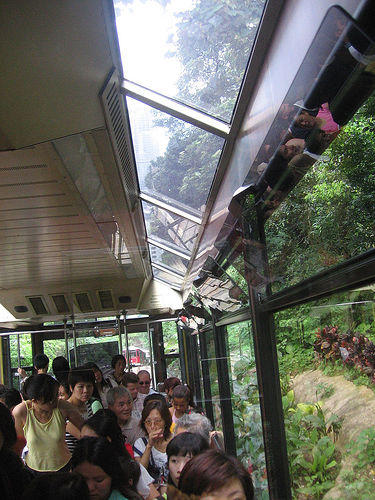
I spent Saturday night wandering around the markets of
and I got up early on Sunday to see 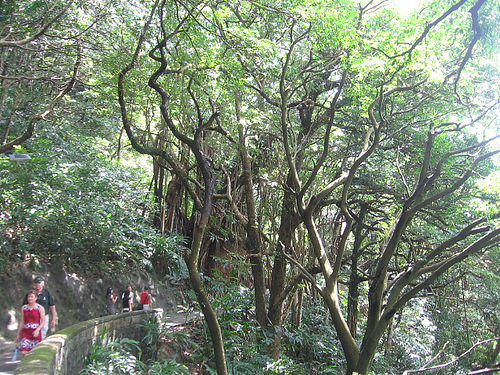 rflies can be seen on the circle walk, and there is no shortage of anxious visitors keen to do so. I ended up taking a bus instead of the tram back down the mountain, enjoying a memorable (if frightening) winding ride through thick tropical forest that inexplicably ends in the center of a metropolis without warning.
Around six I decided to head back to Shenzhen and so returned to my hostel. I hauled my luggage back along the crowded sidewalks to the bus station, purchased a ticket and took a seat in the back. I waited in line to exit Hong Kong and found my bus to take me to the entry border to
“Your visa is expired,” he informed me.
“What!?”
“You have only one entry on this visa. You must return to
I had only received a single-entry visa to enter
One of the first things Mr. Xu did for me when I arrived in Shenzhen was to print out for me an information sheet in Chinese explaining my situation as an intern, the address of the office, and his phone numbers. If I got lost somewhere or needed help, I could then show the paper to a taxi driver or someone on the street to get assistance. Now I pleaded with the border worker to call Mr. Xu, not so much in the hopes of being able to return, but so he would know why I wasn’t going to be at the teacher training on Monday morning. The man took my paper and directed me to a different office and officer on the exiting side of the border. There I waited for another few minutes before the new officer returned my passport and paper and sent me on my way.
“You go back to
Back on the Mong Kok bus, back in line to enter
My last day in
Hope you’re all enjoying your July. I’ll try to write more tomorrow. -joe
Subscribe to:
Posts (Atom)